Chapter One: An Acoustics Primer
12. What is reverberation (reverb)?
Reverberation, or reverb, is the prolongation of sound waves via multiple reflections. While it may occur continuously during the course of a sonic event, it is most noticeable and measurable after the source impulse has ended. Reverb is distinguishable from simple multiple echoes, such as shouting into a canyon might produce, by the rapid build-up of reflective density to a point where the individual reflections are indistinguishable. Reverb is created naturally in an enclosed environment, but can also be created artificially through electronic means.
The amount of time a sound impulse takes to die away is called the reverb time. A standard measurement of an environment's reverb time is the amount of time required for a sound to fade to -60 dB. This amount of time is called T60, a term coined by acoustic engineering pioneer Wallace Clement Sabine (1868-1919). Concert halls will normally have much longer reverb times than small rooms, normally around a T60 of 2.5 seconds—perhaps not as long as that of tunnels or the Notre-Dame de Paris Cathedral, which had a reverb time of approximately 6 seconds or more. Rooms with long reverb times are called wet and those without are called dry. The last perceptible sound to reach your ears in a room with a T60 of 3 seconds will have circuitously traveled approximately 1 kilometer or two-thirds of a mile!
The sound waves that reach the listener's ear directly from the sound source are often referred to as the direct sound. These waves reach the listener's ears first (the exception being electronic pre-echo), followed by sound reflected off walls, ceilings and other surfaces, called echoes. The first reflected sounds to reach a listener's ears are called early reflections. Since they travel a longer path, compared to the direct sound, the amount of time it takes the first reflected sounds to reach our ears gives us clues as to the size and nature of the listening environment. In artificial reverbs, this time gap prior to the first early reflection echo is referred to as pre-delay. Because the reflected sound may continue to bounce off many surfaces, the early reflections become more dense, and eventually a continuous stream of sound fuses into a single perceived entity which persists after the original impulses cease. The stream of continuing sound is called reverberation, and past the point of discernible early reflections is often referred to as late reverberation. After a certain period of time, the echo density is so great that it approaches the characteristics of Gaussian noise, a fact that artificial reverb programmers took advantage of, rather than computing every possible echo for every sample. The residual reverberated sound decay after the source sound has ended is referred to as the reverb tail, though that term is often used synonymously with late reverberation.
Room characteristics are responsible for many facets of the reverberated sound. The proximity of surfaces such as walls, ceilings, floors and other reflective obstacles affect the start and density of the early reflections. The location and acoustic characteristics of the reflective surfaces affect not only the build-up of echoes, but their rate and their frequency response over the time of the reverberation, as well as the shape and ultimate duration of the reverberation itself. The rate of build-up of echo density is proportional to the square root of the volume of the room, so a smaller room will have a faster build-up. Early reflections, when these echoes are dense enough, will interact constructively and destructively and form a comb effect that enhances some frequencies and diminishes others, related to room modes and a factor called diffusion, which affects the phase coherence of these echoes (see the artificial reverb section for more detail on diffusion).
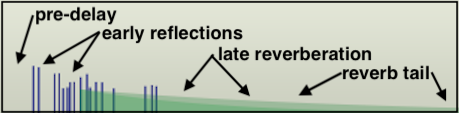
ANATOMY OF REVERBERATION
Image created with Mark of the Unicorn's Digital Performer eVerb plug-in.The time-domain and frequency-domain reverb characteristics of an environment can be represented by its impulse response (IR), which is equivalent to subtracting the original sound from its reverb and quantifying it or, for artificial reverbs, storing it as an impulse response file. These IR files (which appear simply as audio files) are often made by playing a rapid frequency sweep from low to high, recording the reverberated sound of the environment at the location desired (for example, front of house, back of house, left seats, right seats, onstage, etc.), and then subtracting the known impulse of the sweep. A second method, used in conjunction with the sweep, is to create a sharp impulse, often with a popped balloon or starter's pistol, and again subtract that from the resultant sound. This gives both time and frequency response data for the particular environment. Combining digital sound files with an impulse response file in a process called convolution will result in something equivalent to playing the sound in that hall, depending on the quality of the IR file. Many high-end digital reverb units have stored impulse responses from famous concert halls, and today, impulse response files from famous halls, clubs, churches, or even flowerpots and beer cans are available on the web (click here for audio examples). Later, we will see how digital filters are also measured by their impulse responses.
Because of the inverse-square law described earlier, along with the absorption by the environmental materials, reverberated sounds will eventually lose enough energy to drop below the level of perception, even in an untreated environment. In a natural environment, the decay shape of reverb is exponential. With artificial reverb, the decay can be anything you want, including positive gain, where instead of dying out the reflections build up in strength.
The prediction of reverb time and frequency response in a concert hall design, and the variable decay time of different frequencies, keeps acoustic designers up at night. One studied fact is that most people prefer the first early reflected sound to arrive in around 30 ms or less, but no more than 50 ms in a concert hall. The Concertgebouw in Amsterdam has a first reflected arrival time of 21 ms, while Royal Albert Hall has a less pleasing time of 65 ms. In addition, people tend to prefer longer reverberation times for low frequencies than for higher ones.
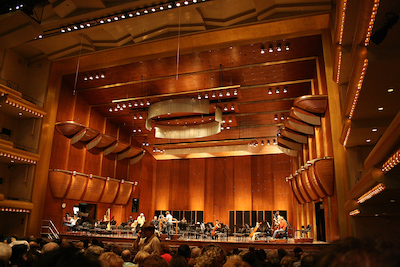
The New York Philharmonic's Home Concert Hall
Even the famous home of the New York Philharmonic orchestra at Lincoln Center, Philharmonic→Avery Fisher→David Geffen Hall, has undergone several major renovations to improve the reverberance-related acoustics—many listeners were, and still are, unhappy. "The sidewalls are too far apart to provide early reflections to the center seats. The ceiling is high to increase reverberation time but the clouds are too high to reinforce early reflections adequately." Robert C. Ehle "What Does It Take to Make a Good Hall for Music?" Music Teacher International Magazine
