Chapter One: An Acoustics Primer
11. What is reflection?
Sound waves reflect from harder surfaces the same way billiard balls bounce off the bumpers of a pool table; the angle of incidence equals the angle of reflection. A sound wave striking a flat wall at 45 degrees reflects at 45 degrees. These bounces will continue until the sound has been completely attenuated by the inefficient reflection—referred to as damping—of the surfaces, along with the natural attenuation of the sound waves themselves.
Angles of Incidence = Angles of Reflection
The reflected wave may interfere with the originating sound wave (called the incident wave) and cause constructive and destructive interference in the listening environment as they overlap. A sound wave reflecting off a wall perpendicularly (at 90 degree) can cause standing waves. The video below demonstrates two-dimensional reflections off a single wall, and then off of three walls, excluding reflective floor and ceiling surfaces. Note the interference patterns created in each scenario.
Flat Wall Reflections
Simulations were created using free Falstad applets at www.falstad.com. Try them!Because of maximum constructive interference at the point of reflection off a hard surface, a thin area called a pressure zone is created where the original incident amplitude doubles and power quadruples. Pressure zone microphones (PZM), mounted just off the reflective surface, take advantage of this phenomenon.
In a typical listening environment, listeners perceive sounds that have reflected off numerous objects and surfaces, with the reflections themselves interfering with other reflections. Just as color is determined by which frequencies of light are reflected or not, the acoustic characteristics—or "color"—of a particular environment are determined by the angles and materials the sound may reflect off of. Different materials reflect some frequencies more efficiently than others, due to their roughness or absorbency characteristics. Acoustic foam or fiber panels, for example, do not reflect higher frequencies very efficiently, but have little effect on particularly low frequencies—we need something called a bass trap for that. The distances traveled by both incident and reflected sounds is another key element in the characteristics of an acoustic environment, since the incident sound typically reflects from multiple surfaces at differing distances from the listener, thereby striking the ears at differing times.
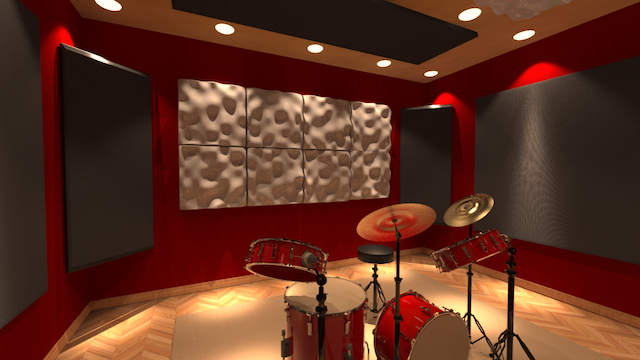
Acoustic Treatment of Reflections
In addition to absorption materials, sound diffusion panels (of which thousands of designs exist) attempt to avoid the formation of standing waves from flat surfaces by providing many geometric contours that prevent perpendicular reflections. Pictured here are ALPHAcoustic Ocean-wave Sound Diffusers.
