Chapter One: An Acoustics Primer
17. What is Timbre?
Our perception of timbre, or tone quality, seems most closely related to the physical phenomenon of the relative strength of the partials in a sound—its spectral envelope—and the way that spectrum unfolds and shifts over the life of a note. It is what allows us to distinguish between two different instruments playing the same note at the same amplitude. What we expect of familiar sounds, say a piano note, are certain characteristics that change over time. If one were to chop off the attack of a piano note and hear the remainder, it may not sound very piano-like to us at all. As mentioned above, the first systematic studies of timbre were written in the 19th century by Helmholtz in his book On the Sensations of Tone, in which the relative strengths of the harmonic partials—the steady-state spectrum of a complex waveform—formed the basis for his theory of tone quality. Fourier had already supplied the mathematics, showing that any complex periodic wave can be expressed as a sum of sine waves; what we now understand is that the way this spectrum unfolds over time completes the picture.
We say sounds with stronger upper partials sound "brighter," and those with weaker upper partials sound "duller." More natural spectra will roll off with varying slopes at higher frequencies. Computer music is capable of creating any rolloff desired. Harmonic sounds with roughly equal energy across their partials are often characterized as "buzzy." Noise with equally strong high-frequency components is characterized as being more "hissy."
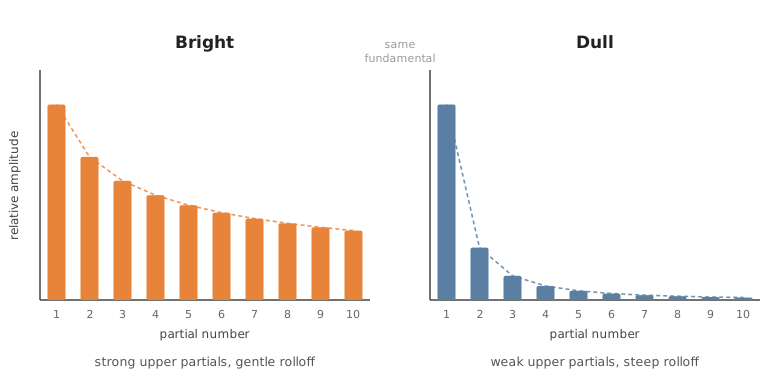
Two harmonic spectra on the same fundamental: a bright timbre (gentle rolloff) and a dull one (steep rolloff). The dashed line traces each spectral envelope.
Other aspects of timbre include vibrato, an oscillation of frequency (most important), and tremolo, an oscillation of amplitude (less important). Violins have very narrow formants (or resonating frequencies), and the addition of vibrato may push a tone in and out of a peak formant region, making for a very dynamic sound. This is further tempered by our perception of the complex of formants for a particular sound or instrument regardless of its register, so that, although somewhat different, a low clarinet note may still be considered related to a much higher one. The art of orchestration depends heavily on the ability of a composer to mix the spectra of numerous instruments, not necessarily playing the same pitch or octave doubling, and create a single timbral entity, perhaps unheard before. Most wind players are familiar with the slang term floboe, referring to the frequent octave doubling of melodic lines by a flute and oboe in Classical symphonies.
Some studies have indicated it takes at least 60 ms to recognize the timbre of a sound. It has also been hypothesized that we can hear differences in tones up to roughly the 30th partial—recall how closely spaced the higher partials become, and how soft they usually are in natural sounds. Temporal relationships also form an aspect of timbre. Though highly influenced by the intervallic distance between pitches, if a series of tones is played rapidly enough, they will merge into a single timbre in a process called fusion. With sufficient reverberation, even disparate tones can fuse. Stockhausen used this principle in Studie II to create mixtures of sine tones played through a reverberation chamber to create unique timbres.
Finally, instruments do not radiate their spectra equally in all directions, making it tricky to mic such instruments and gather their full tonal qualities (see the excellent diagram of the radiation pattern of a cello in Huber and Runstein, Modern Recording Techniques, 7th ed., p. 57).
Helmholtz: Sensations of Tone
On the Sensations of Tone as a Physiological Basis for the Theory of Music or simply Sensations of Tone was first published in German by physicist Hermann von Helmholtz (1821–1894) in 1863, readable in its English translation (1875) here. Helmholtz focused on the human physiology's response to sound, building pioneering acoustic testing apparatus, such as the Helmholtz resonator, in collaboration with acoustic-instrument maker Rudolph Koenig. Helmholtz also worked in other areas of human perception, such as the eye, designing the first practical ophthalmoscope.
