Chapter One: An Acoustics Primer
9. What is phase? | Page 2
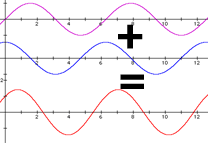
When waveforms of either identical or differing phases are combined, they interfere with each other, and their instantaneous amplitudes are summed to create a new composite wave. This is a relatively predictable process with electronic circuits, yet becomes significantly more complex in the realm of acoustic sounds, as we will see below. For waves of differing phases, the fraction of a period between peaks defines the phase difference and is also expressed in degrees, as demonstrated by sine and cosine waves.
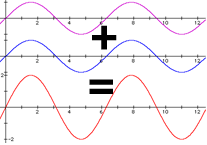
Two waves with the identical frequency and phase will combine to create a single sound of greater amplitude—this is called constructive interference (pictured below).
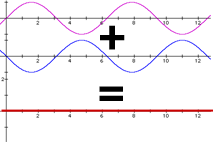
Two identical waves 180° out of phase will completely cancel each other out in a process called phase cancellation or destructive interference (pictured below).
Often there is a combination of both destructive and constructive interference, as pictured below in a mix of a sine wave and cosine wave of equal amplitude and frequency. The resulting waveform is a sinusoidal wave of slightly greater amplitude than either component, but slightly out of phase with both.