Chapter Two: Studio Gear
4. Mixing Consoles
A mixing console is used for a wide variety of purposes in a computer music or audio recording studio. It is also standard equipment for live sound and concert playback, so electronic composers should familiarize themselves with boards and mixing principles in general. Fortunately, analog, digital, and even the virtual mixers on a DAW screen are all built around the same basic framework.
Mixing consoles are often classified by their input and output (I/O) configuration. For example, a 32 × 8 mixer would have 32 input channels and 8 output buses. Most professional boards offer many more inputs and outputs beyond the main I/O. In addition, boards can serve as signal-routing devices, moving audio signals from one device to another.
Digital mixing consoles, once found only in expensive commercial studios, have become much more common in smaller studios as well. These boards accept analog signals from sources such as microphones, converting them to digital at the input stage, and can also take digital signals directly from synths and computer audio interfaces. A digital board's specifications, in addition to its basic channel count, include digital I/O formats such as AES/EBU, TDIF, ADAT Lightpipe, and S/PDIF—all different forms of digital connection and transmission protocols.
Most digital boards, some analog boards, and virtually all DAW software mixers have some form of mixing automation, in which fader moves, equalization, auxiliary (aux) sends, and panning can be recorded, synced to audio tracks or timecode, then rehearsed and modified. Back in the day, boards whose faders physically moved under automation were said to have flying faders. Before that, one might need to get a bunch of friends and use a stopwatch to choreograph every control move a complex mixdown required. Digital boards are also highly configurable: stored scenes or snapshots can reassign the function of each input or output channel at the touch of a button.
The figure below shows the layout of the various sections of a typical analog mixing console. Each of these sections will be examined in turn over the next several pages.
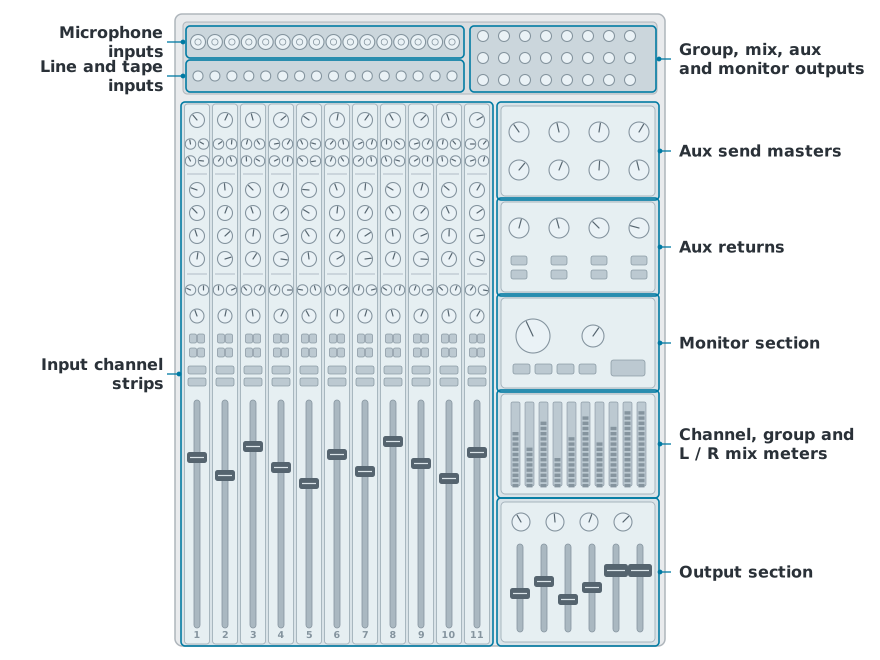
The functional sections of an analog mixing console. The rear edge carries the input and output connectors; the left two-thirds of the surface holds the input channel strips; the right third holds the master section—aux send masters, aux returns, monitoring, metering, and the outputs. Channel counts vary from board to board, and so does the layout of the master section; the channel strips are the part you can count on finding in much the same form on any console.
