Chapter Two: Studio Gear
3. Microphones | Page 3
Microphone Types
There is an incredible variety of microphones available on the commercial and used market, from a $5 karaoke special to microphones costing $20,000 and up for a vintage tube type.
For all this variety, most fall into one of the following five basic types (select to scroll to mic type):
Dynamic | Condenser | Ribbon | Boundary (PZM) | Contact
Dynamic Mic: Electrical generators create current by passing coils of conductive wire past magnets. This principle is known as induction. A dynamic microphone works on the same principle. A coil of thin wire called a voice coil is attached to the diaphragm. The coil sits in a narrow gap in a fixed magnet assembly, close to the poles but free to move without touching them. As sound waves flex the diaphragm, they cause the coil to move into and out of the magnetic field of the magnet, thereby inducing a fluctuating voltage in the coil (pictured below). These are often referred to as moving-coil dynamic mics. As mentioned, they are essentially small loudspeakers in reverse.
Dynamic mics are best used for loud sounds or sounds that may contain sharp transients, as they can handle extremely high SPLs without distortion. They are not as good for minute detailed sounds and usually do not have the high-frequency response of a condenser microphone because of the added mass of the coil attached to the diaphragm. Therefore, their frequency response is considered colored. While they can be omnidirectional when sound only hits the diaphragm from the front (called a pressure pickup), side acoustic ports and channels allow a time-delayed version of the front sound wave to also reach the rear of the diaphragm and cancel out of phase, thereby creating a cardioid pattern. This arrangement is called a pressure-gradient pickup. They are passive in that they require no phantom power to function, and they create virtually no self-noise due, in part, to their lack of a preamp. Their internal electronics are usually very simple, consisting of a transformer to step up the weak voltage from the coil, change impedance, and in some cases add a center tap to turn the mic output into a balanced signal. Dynamic mics are usually cheaper and more robust than condenser mics, so if your performer is planning a "drop the mic" moment, best to go with this type (though you'd be better off dropping the performer). The ubiquitous Shure SM57 and SM58 mentioned on the previous page are examples of dynamic microphones with pressure-gradient cardioid patterns and a balanced output.
Condenser Mics: A condenser mic works on an electrostatic principle, not an electromagnetic one, as in the dynamic mic. The capsule consists of two plates, separated by a very small distance, that are electrically charged, forming a capacitor (which older texts call a condenser, hence the name).
Condenser capsule with an external polarizing supply; schematic, not to scale.
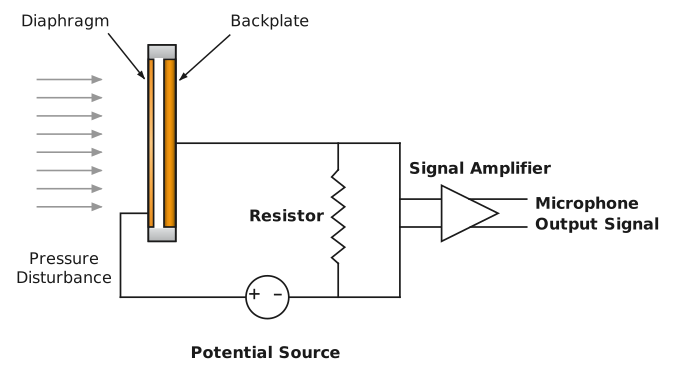
Redrawn and relabeled after an illustration by Doktorcik at English Wikibooks, public domain, via Wikimedia Commons.
One of the plates, often called the backplate, is fixed; the other is part of the microphone diaphragm and is usually thinly gold-plated Mylar or similar thin film. As sound waves hit the diaphragm, the width of the air gap between the charged plates changes, producing equivalent fluctuations in the capacitance and hence in the charge held on the plates, which flows to and from them through the external circuit. An additional component, a resistor, is attached across the leads of the two plates, and it is the fluctuating voltage across that resistor that is sent out as the mic's signal.
Most directional condenser mics are pressure-gradient, meaning part of the sound wave is let in behind the diaphragm through ports and a time-delaying narrow labyrinth. In addition, most condenser mics have a built-in preamp, though some attach to an external one. When a condenser mic distorts from acoustic overload, it is usually the preamp rather than the diaphragm that causes the issue. For this reason, most of these mics have attenuators to reduce the voltage into the preamp. However, it is best to remove this attenuation pad when not needed, as it will worsen the mic's signal-to-noise ratio if you need to crank the volume up for softer sounds. Vintage and vintage-based new mics may use an actual vacuum tube rather than an FET in their preamp circuit for a "warmer" old-time sound. The reissued Neumann U67, a studio staple since 1960 and heard on countless Beatles sessions at Abbey Road, is an excellent example of a large-diaphragm tube condenser mic found in many high-end recording studios.
As can be seen on the following page, many condenser mics feature a second capsule attached to the rear of the backplate. By varying the polarity and strength of the signal from the rear capsule (often with switches on the microphone), multiple patterns can be obtained from the same microphone. If the front and rear capsules are in phase, an omnidirectional pattern is created. If the phase of the rear capsule is inverted, a variety of patterns, from cardioid to figure-8, can be had by varying the amount of signal from the rear capsule. Some microphones feature an infinitely variable pattern adjustment.
To charge the plates, condenser mics need a form of power called phantom power. This is supplied by most professional mixing consoles or digital audio interfaces and is usually labeled +48 volts DC or PWR—if you need phantom power from the board, look for a switch on individual channels or channel groups. Phantom power from a console or interface requires a balanced line, since the +48 volts is applied equally to both signal conductors (pins 2 and 3), with the shield (pin 1) serving as the return path. Some condenser microphones are self-powered with a battery, designed to go dead at the worst possible moment. Some mics, such as the Røde NT5s, can run on either phantom power or a battery, and small wireless mics run on a lower-voltage bias supply from a battery, often in a belt pack. The AKG C414, for example, is a condenser mic that requires phantom power.
Condenser mics normally have superior, flatter frequency response compared to dynamic mics but are much more easily overloaded by high-SPL transients. So, they are good for recording most instruments and small bug noises—bad for close-mic'ing bass drums and howitzers.
A variation of a condenser mic is called an electret or electret-condenser. This mic type has a permanently charged element—the electrostatic equivalent of a permanent magnet—requiring no phantom power. Better versions will have an internal preamp that does require power. Often, these are of back electret design, meaning the electret material is applied to the backplate and thus allows for better frequency response by not adding mass to the diaphragm. Electrets can, however, lose their charge or efficiency in high heat and humidity, and with age.
Ribbon: Ribbon mics work on yet another principle, which responds to the velocity of the air molecules, not just the SPL of sound passing over its element. An unbelievably thin corrugated ribbon of aluminum—or more recently a polyester film with aluminum printed on it—is placed over a magnet or between magnets. As the film moves when hit by air molecules, the changes in induction between the ribbon and the magnets produce a fluctuating voltage, much like a dynamic mic. Because the ribbon's output voltage is so small, however, a preamp, internal or external, is required, as with the condenser mic. The electronics also balance the output in most newer versions. Ribbon mics have been around since the 1930s, often seen on the desks of late-night TV hosts or hanging from the ceiling in wrestling rings. However, mics such as the Beyerdynamic M160 may use rare-earth magnets that allow for a much smaller capsule. You may see these in some of the "ball" design mics. Passive ribbon mics require no phantom power—and on a vintage ribbon it can stretch or destroy the element, so switch it off before plugging one in. Newer active ribbons do use phantom power, but only to run an internal preamp.
A ribbon element suspended between the poles of two permanent magnets; schematic, not to scale.
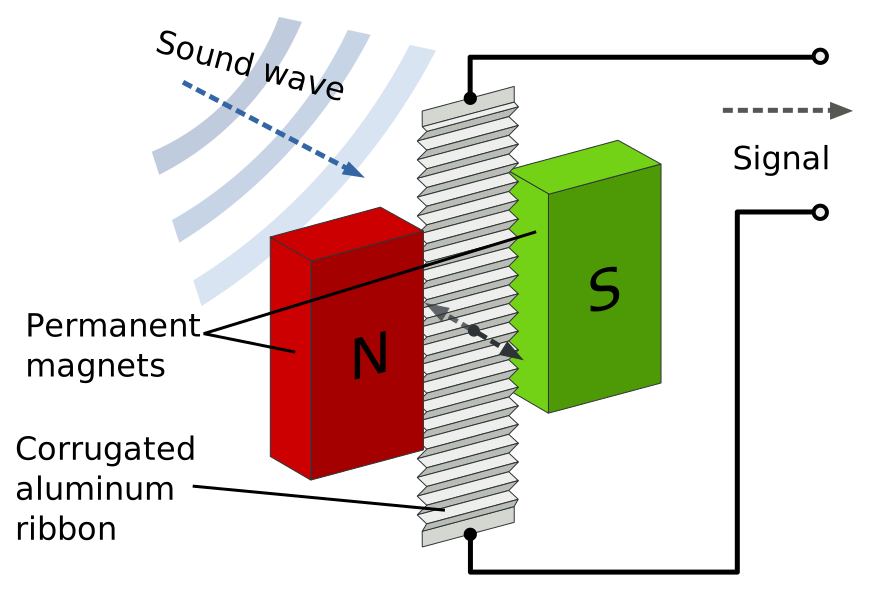
Modified from an illustration by Arne Nordmann (norro), Bändchenmikrofon-en.svg, CC BY-SA 3.0. Relabeled and restyled; this modified version is likewise licensed CC BY-SA 3.0.
Boundary or PZM: Short for pressure zone microphone, PZM (a trademark of Crown) or a boundary microphone uses a small electret element suspended over the boundary plate, sometimes facing it, sometimes parallel to it. The capsule is mounted to the large, flat boundary plate which picks up the reflected waves from the surface, thereby doubling its output from that constructively amplified pressure zone, as we saw on the reflection page. Because it is placed on a surface, the polar pattern is normally half that of a regular mic, so it creates a hemisphere of sensitivity above and around the mic. While used for low-quality recordings of business meetings or perhaps CIA interrogations by putting a PZM mic in the center of a conference table, newer, higher-quality models are now used to reinforce pianos from inside the lid, where feedback is less likely. One issue is that if the surface it is mounted on is too small, lower frequencies will not be reflected due to their larger wavelengths. Some recording engineers use boundary mics, such as the Shure SM91 (now the Beta 91A), inside kick drums since they tolerate extremely high SPL.
The Audio-Technica ATM87R, a condenser boundary microphone.
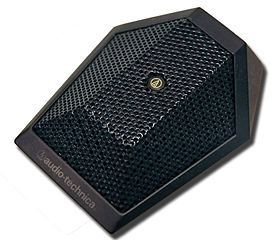
The capsule sits just above the plate, which forms the reflective surface. Photo by Galak76~commonswiki, CC BY-SA 3.0, via Wikimedia Commons.
Contact or Piezoelectric Mic: A contact mic or pickup is a thin disk containing ceramics or a crystal that generates a voltage when flexed or stressed. The disk is normally stuck to or clamped onto an instrument and picks up most of its signal from the object's mechanical vibration rather than from airborne sound, using piezoelectric principles (discovered by Pierre and Jacques Curie in 1880). It is often used for mic'ing instruments where feedback or unwanted sounds from other instruments would be an issue. It can also be attached to homemade instruments and pretty much anything that vibrates mechanically. Cheap piezo pickups can be made at home from inexpensive buzzers sold by electronics suppliers, usually by chipping off their outer plastic covering.
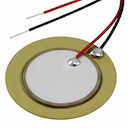
An electric buzzer with its case removed can be used as a contact microphone.
One of the drawbacks of using a contact microphone on acoustic instruments is that it emphasizes frequencies resonating at a particular spot on the instrument, thereby creating a misrepresentation of the overall timbre of the instrument. For this reason, many performers have gone back to conventional airborne microphones or clip-on condenser mics, such as the DPA or ATM line. When using contact mics, experiment with different placements on the instrument, be it a string bridge or a clarinet barrel.



